Video Foundation Model Researcher
Juncheng Wang
I build self-evolving agentic systems that treat generators as callable tools inside plan–execute–verify loops, with the planner trained by reinforcement learning on critic feedback — test-time scaling for generative media: scale the workflow, not the generator.
Scaling decides how well a model renders. It cannot decide what was never specified.
Currently researching next-generation video foundation models at Tencent Hunyuan. Previously at AMD and Alibaba Wan.
A Roadmap for Video Generation
Where the conditioning comes from — and who is responsible for writing it.
Scaling decides how well a model renders.
It cannot decide what was never specified.
A prompt is a lossy description of a physical scene — on VideoPhy-2 even the best models clear only about a third of joint physical accuracy. More compute sharpens the renderer; it cannot recover what the prompt never contained. So the thing that keeps moving is the conditioning, and who writes it.
-
L1Text condition
written by a human
Say it
The prompt is the whole contract.
One sentence has to specify a long, coherent, high-rate signal, and all of that difficulty lands on the decoder. Siren spreads the load across residual codebooks instead of asking one model to carry all twelve.
-
Language Model Based Text-to-Audio Generation: Anti-Causally Aligned Collaborative Residual Transformers
ArchitectureEMNLP 2025 · first author
-
-
L2Reference condition
written by a human, in pixels
Show it
Point at what language cannot describe.
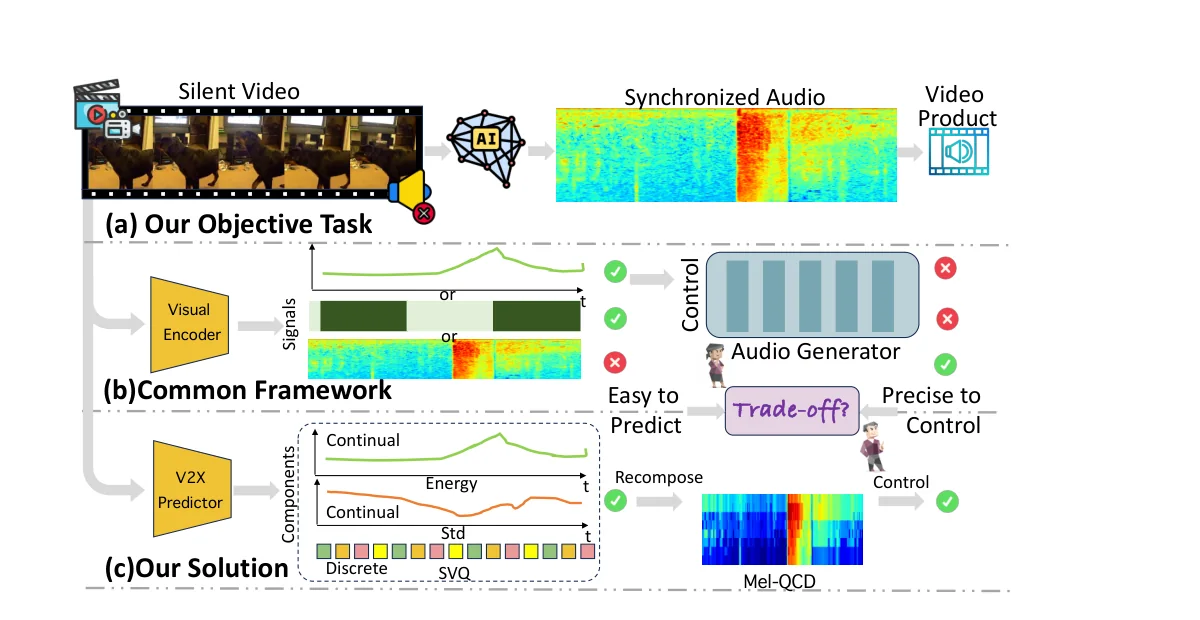
Layout, timing, identity — easier to show than to say, so conditioning turns structural. DenseControl places every individual in a dense crowd; MelQCD takes the condition from another modality entirely. Precision rises, and a human still has to supply the reference.
-
DenseControl: Instance-Level Controllable Synthesis of Dense Crowd Image
Spatial controlIEEE TMM 2026 · first author
-
Synchronized Video-to-Audio Generation via Mel Quantization-Continuum Decomposition
Cross-modal controlCVPR 2025 · first author
-
-
L3Searched condition
written by search, at inference
Find it
Buy the missing half with test-time compute.
If the specification is incomplete, go looking for the rest. Gen-Searcher retrieves external evidence before it draws; my own work spends the budget internally — Guided by the Plan steers decoding to stay faithful to a plan, Think Before You Move reasons in latent motion space before the first pose. The ceiling rises while the weights stay put.
-
Guided by the Plan: Enhancing Faithful Autoregressive Text-to-Audio Generation with Guided Decoding
Steered decodingEACL 2026 · first author
-
Think Before You Move: Latent Motion Reasoning for Text-to-Motion Generation
Latent reasoningIEEE TPAMI 2026 · co-first author
-
-
L4Composed condition
written by a fixed pipeline
Arrange it
Orchestration becomes a component.
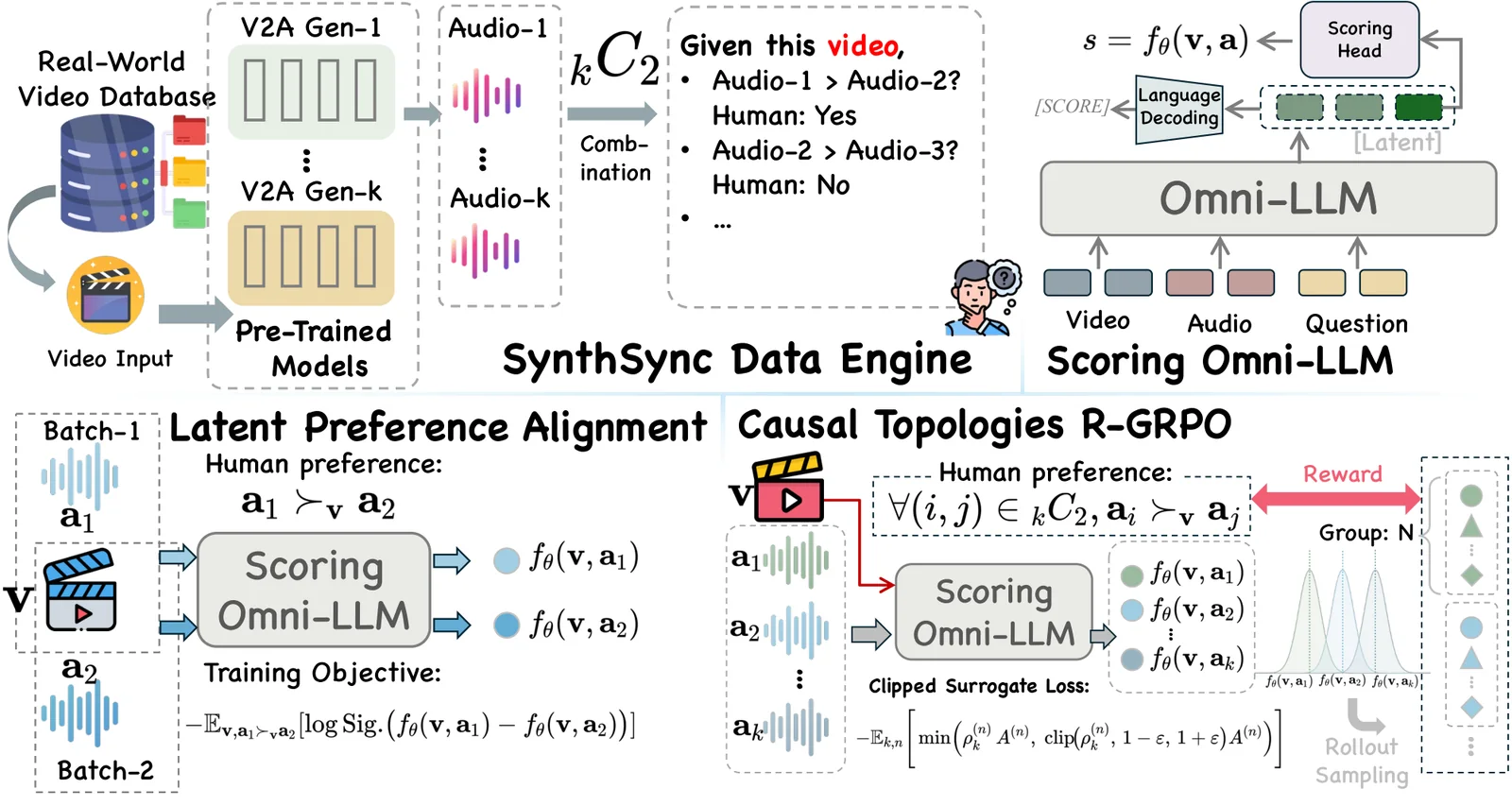
Once text, images, audio and clips all condition one model, arrangement is the bottleneck — MiniMax H3 promotes it to its own module. But a loop cannot close on a metric it does not have: Beyond Time Shifts turns an omni-LLM into a reference-free critic for audio-visual quality and sync.
-
Beyond Time Shifts: Adapting Omni-LLM as a Reference-Free Evaluator for Generative Audio-Visual Models
The verifierECCV 2026 · co-first author
-
-
L5Self-improving condition
written by a trained planner
Learn to arrange it
Give the orchestrator a gradient.
NEWTON demotes generation to one action in an agent’s toolbox: a planner orchestrates physics-aware tools, a verifier closes the loop for re-planning. Only the planner trains — VideoPhy-2 joint accuracy 21.4 → 29.7 on LTX-Video and 30.7 → 37.4 on Veo-3.1, with both generators untouched. ROC-Agent runs the same loop one level up, on research itself. What improves is the harness, not the weights.
-
NEWTON: Agentic Planning for Physically Grounded Video Generation
Trainable orchestrationUnder review at ICLR 2027 · co-first author
-
ROC-Agent: Research Orchestration via Cyclic Agents for Autonomous Deep Learning Experimentation
The loop, one level upUnder review at ICLR 2027 · first author
-
The next level gives the weights back what the harness learned.
Levels 1–4 changed who writes the conditioning; L5 made that writer trainable. What is missing is internalization — folding verified harness improvements back into the generator, until the model no longer needs the scaffolding. That is where I am working now, and I would happily be argued out of it. Get in touch.
Selected Work
Generation, planning, and feedback for multimodal systems.
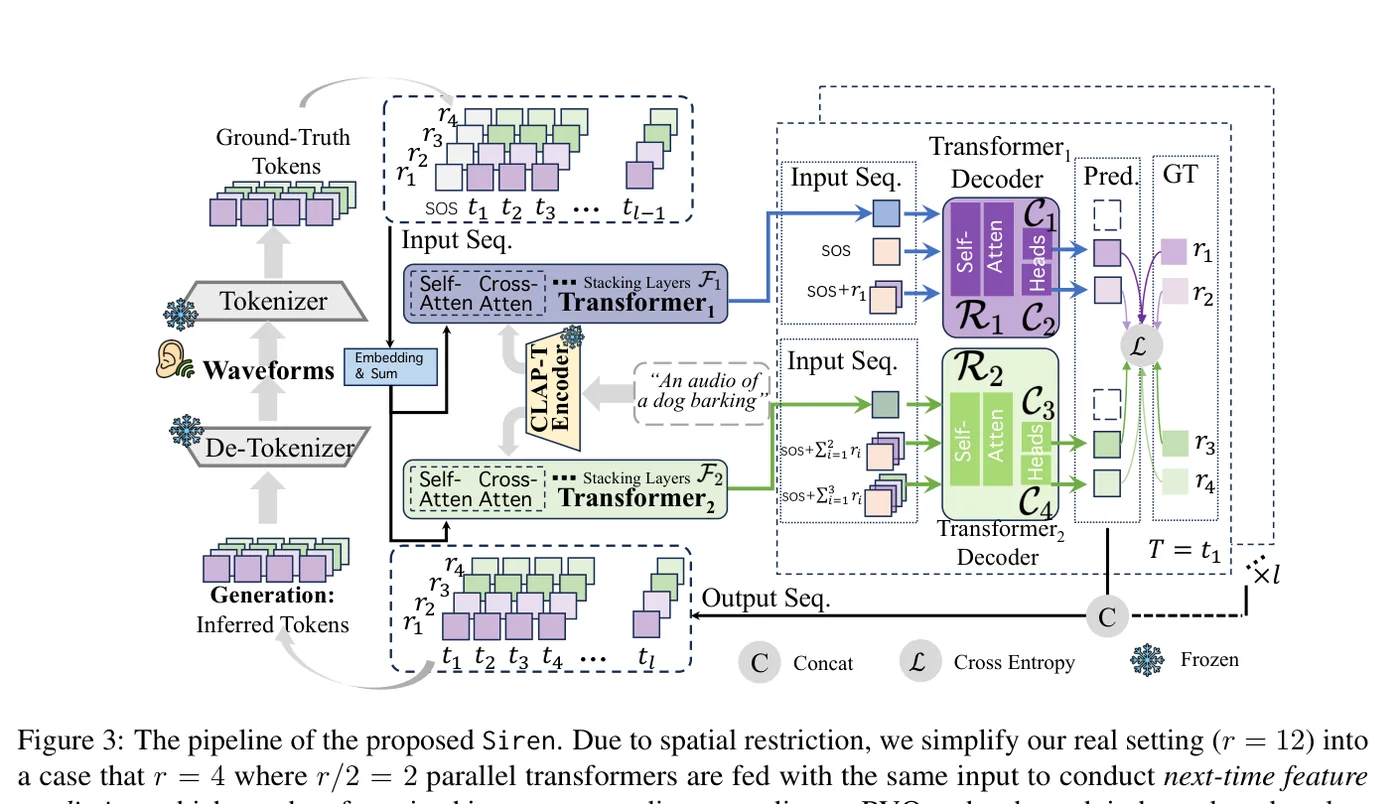
Language Model Based Text-to-Audio Generation: Anti-Causally Aligned Collaborative Residual Transformers
Introduces Siren, a collaborative residual-transformer architecture that resolves imbalanced RVQ prediction difficulty and improves autoregressive text-to-audio generation.
Education
2024.01 — 2027.08
The Hong Kong Polytechnic University
Ph.D. Student
Thesis: Clone Your Instance: Towards Omni-Modality Creation of Digital Twins with Real-Time Interactions.
Advisor: Prof. Emma, Shujun Wang
2018.09 — 2022.06
Northwestern Polytechnical University
B.Sc. in the School of Automation
Industry Experience
2026.06 — Present
Tencent · Hunyuan-Video Group
Qingyun (Project Up) Intern
Pre-training research for the next generation of Hunyuan video foundation models.
Working with Dr. Jianwei Zhang
2026.01 — 2026.06
Advanced Micro Devices (AMD)
Student Research Fellow
Efficient flow-model research for video generation.
Mentored by Dr. Tong Shen and Dr. Emad Barsoum
2023.09 — 2025.09
Alibaba · Wan Group, Tongyi Lab
Research Intern
Post-training for foundational video generation and audio-centric generative modeling.
Mentored by Dr. Chao Xu, Lei Shang, and Dr. Liefeng Bo
Publications
† Equal contribution. * Junior student advisee.
-
NEWTON: Agentic Planning for Physically Grounded Video Generation
Yuxiang Feng†, Juncheng Wang†, Chao Xu, et al.
-
ROC-Agent: Research Orchestration via Cyclic Agents for Autonomous Deep Learning Experimentation
Juncheng Wang et al.
-
Think Before You Move: Latent Motion Reasoning for Text-to-Motion Generation
Juncheng Wang†, Yijie Qian*†, Yuxiang Feng*, Chao Xu, et al.
-
SphereFlow: Missing Modality Imputation via Geometric Transport on Hypersphere
Juncheng Wang†, Huihan Wang†, Yuxiang Feng*, et al.
-
Beyond Time Shifts: Adapting Omni-LLM as a Reference-Free Evaluator for Generative Audio-Visual Models
Juncheng Wang†, Yijie Qian*†, Chao Xu, et al.
-
Progression as Latent Drift: Generative Forecasting of Slow-Evolving Pathologies
Juncheng Wang†, Yuxiang Feng*†, Chao Xu, et al.
-
Decentralized Attention Fails Centralized Signals: Rethinking Transformers for Medical Time Series
Guoqi Yu*, Juncheng Wang, Chen Yang, Jing Qin, Angelica I. Aviles-Rivero, and Shujun Wang.
-
Guided by the Plan: Enhancing Faithful Autoregressive Text-to-Audio Generation with Guided Decoding
Juncheng Wang, Zhe Hu, Chao Xu, Siyue Ren, Yuxiang Feng, Yang Liu, Baigui Sun, and Shujun Wang.
-
Language Model Based Text-to-Audio Generation: Anti-Causally Aligned Collaborative Residual Transformers
Juncheng Wang, Chao Xu, Cheng Yu, Zhe Hu, Haoyu Xie, Guoqi Yu, Lei Shang, and Shujun Wang.
-
Synchronized Video-to-Audio Generation via Mel Quantization-Continuum Decomposition
Juncheng Wang, Chao Xu, Cheng Yu, Lei Shang, Zhe Hu, Shujun Wang, and Liefeng Bo.
-
DenseControl: Instance-Level Controllable Synthesis of Dense Crowd Image
Juncheng Wang, Lei Shang, Wang Lu, Baigui Sun, and Shujun Wang.
-
Exploring Scale Shift in Crowd Localization under the Context of Domain Generalization
Juncheng Wang, Lei Shang, Ziqi Liu, Wang Lu, Xixu Hu, Zhe Hu, Jindong Wang, and Shujun Wang.
-
Crowd Localization from Gaussian Mixture Scoped Knowledge and Scoped Teacher
Juncheng Wang, Junyu Gao, Yuan Yuan, and Qi Wang.
Selected Awards & Honors
2022
NWPU Excellent Bachelor Thesis
Selected 2 out of 239.
2021
Chinese National Scholarship
Rank 2 out of 239, as a year-3 undergraduate student.
2021
China Robot Contest
First prize, national level.